What Is a CSA? How CSA Farms, Boxes & Farm Shares Work
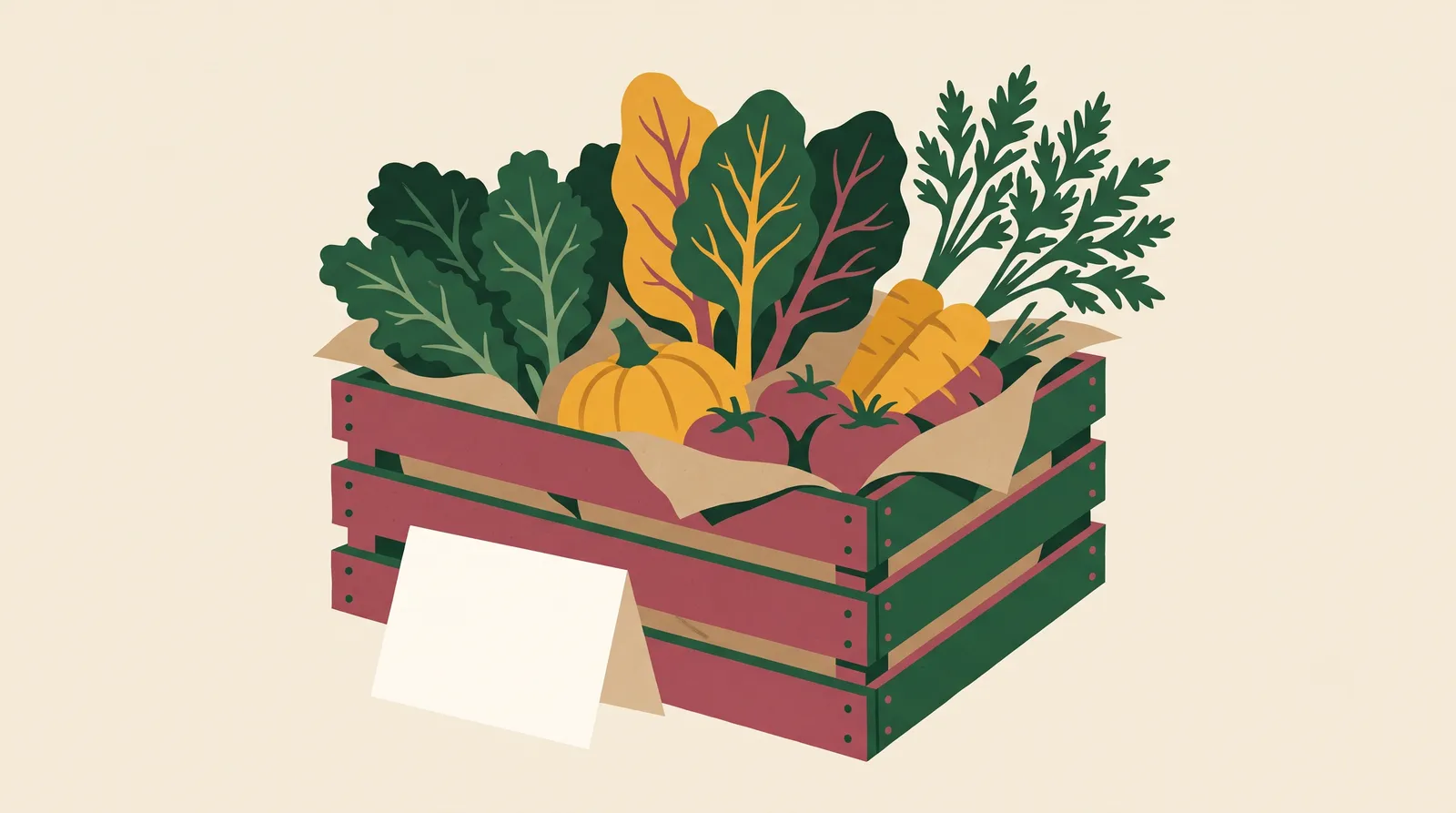
A CSA (Community Supported Agriculture) is an arrangement where you pay a farm up front for a "share" of its harvest and receive a box of fresh, seasonal produce each week through the growing season. It is a direct farm-to-eater model — not a finance, health, or HR term — and it means you share both the bounty and the risk of the farm's season.
What a CSA actually is
Community-Supported Agriculture is a direct deal between you and a farm: you buy a "share" or subscription of the harvest ahead of the growing season, and the farm delivers fresh produce to you regularly through that season. No middleman, no supermarket — just you and the people who grow your food.
The USDA puts it well: a CSA is "a community of individuals who pledge support to a farm operation so that the farmland becomes, either legally or in spirit, the community's farm; with the growers and consumers providing mutual support and sharing the risks and benefits of food production" (USDA National Agricultural Library). The model started in Japan in the 1960s — called teikei, roughly "putting the farmer's face on food" — and reached the United States through New England farms in the mid-1980s, and it's no longer niche: in the USDA's 2022 Census of Agriculture, about 7,240 US farms sold through a CSA — part of a $17.5 billion direct-to-consumer market that grew 25% since 2017, even as the total number of direct-selling farms fell about 10% (USDA NASS). Fewer farms, more dollars — the ones still selling direct are leaning into models like the CSA.
Shared risk: the idea that explains everything
Here's the concept that makes sense of all the rest: you and the farmer share the risk. Because your money comes in before a single seed is planted, you're helping fund the season — and you take on a slice of what could go right or wrong with it.
That single idea explains the parts of a CSA that surprise newcomers. It's why you pay up front (the farm needs operating cash for seed, labor, and equipment before harvest). It's why your box changes week to week and you don't pick the contents (you get what the land produced). And it's why CSA agreements typically don't refund weather-related crop losses — if a hailstorm takes the tomatoes, the money's already in the ground (University of Maryland Extension). In a banner year, that same arrangement means your boxes overflow. You're a member of the farm, not just a customer.
What you get, and for how long
Most farms offer a full share (roughly enough produce for a family of four for a week) and a half share (sized for a two-person household, usually priced a little above half — the farm's labor doesn't shrink by half). Seasons commonly run about 18–22 weeks, late spring through mid-autumn.
What's in the box follows the season: salad greens and spinach early on; sweet corn, tomatoes, and peppers at the summer peak; storage crops like squash, potatoes, and root vegetables in fall (NC State Extension). Expect roughly one to two grocery bags a week, expanding to two or three at peak harvest. Many farms also sell add-ons — eggs, honey, flowers, bread, sometimes meat — alongside the produce share. For a detailed breakdown of exactly what fills those boxes week-by-week, see our guide to what's in a CSA box. If you want to know what's likely in your box any given month, our what's-in-season calendar maps it out. Still deciding whether to sign up? We walk through the real math in is a CSA worth it? — and if you're weighing it against just shopping the market, see CSA vs. farmers market. Comparing it to an online produce box or meal kit instead? That's CSA vs. grocery delivery.
Pickup, payment, and how much choice you get
Pickup is usually on-farm during a set window, at a community drop site, or sometimes a workplace. Payment is traditionally a lump sum up front, though most farms now offer installment plans. And choice depends on the CSA's style.
On pickup, you'll either drive to the farm during a set window, collect from a neighborhood drop site, or grab a box left at a partner workplace — confirm the day and time before you sign up, because a missed window often means a forfeited box. On payment, the traditional lump sum is giving way to deposits plus installments, monthly billing, and even prepaid "farm credit" you draw down over the season. And how much you get to choose comes down to the CSA's model — which is no longer just one fixed box, as the next section lays out.
The 5 kinds of CSA box (and which suits you)
"CSA" no longer means one pre-packed box. Farms now run roughly five models, and the difference is mostly about how much you get to choose and how you pay. Match the model to how you actually cook and budget.
| CSA model | How the box works | Best for |
|---|---|---|
| Traditional (farmer's choice) | The farm fills a set box with whatever was harvested that week; you don't pick the contents. | Adventurous cooks; usually the lowest price. |
| Customizable / build-your-own | Swap items out or build the box yourself through an online portal before each delivery (platforms like Local Line, GrownBy, CSAware, Farmigo, and Barn2Door power these). | Picky eaters and families who'll skip the kohlrabi. |
| Subscription | Pay monthly and pause or cancel anytime instead of one season-long lump sum. | First-timers testing the waters; tighter monthly budgets. |
| Buy-down / farm credit | Prepay a balance up front, then spend it flexibly across the season like a farm debit account. | People whose weekly needs swing a lot. |
| Market-style | Pack your own bag from bins at the farm stand, up to a set count or dollar value. | Choice-lovers who like the farmers-market feel. |
When you compare farms, ask which model they run — it's the single biggest factor in how a CSA feels week to week. Even on a traditional share, many farms add a "swap box" so you can trade an item you won't use.
What a CSA costs
Budget roughly $400–$525 for a full-season share — about $18–$26 a week — with real variation by region and farm. Half shares run a bit above half that. Many farms take a deposit (often around $100) and spread the rest over a few payments.
Those are cited ranges, not a fixed price. University extension data shows how much it moves around — Utah shares average roughly $300–$600, driven by season length, growing practices, and simply what a local market will bear. To judge value, compare a CSA against high-quality local or organic produce, not the cheapest conventional supermarket bin — on that footing it usually comes out ahead. (The advocacy group Green America estimates savings of up to 40% versus retail organic — treat that as their claim, and let your own farm's prices be the real test.) When you have a real price sheet in front of you, our CSA cost calculator turns it into a weekly cost and a break-even you can sanity-check.
What are the disadvantages of a CSA?
The main disadvantages of a CSA are a big payment up front, little control over what's in the box, occasional glut weeks, and shared risk with no refund if the season goes badly. A CSA isn't for everyone, and the good guides say so.
The upfront cost asks for budgeting that pay-as-you-go shopping doesn't. The lack of choice means you'll meet vegetables you didn't plan for — great if you like to cook on your feet, frustrating if you don't. "Glut weeks" are real: when the zucchini comes in, it all comes in, and a box can bury you in one crop. And the shared-risk model cuts both ways — a rough weather year means lighter boxes with no refund. None of this is a reason to skip a CSA; it's a reason to go in clear-eyed. If that commitment sounds like more than you want, a farmers market gives you the same local food with none of the lock-in.
CSA vs farmers market vs grocery store
Same goal — good food — three different trade-offs between choice, commitment, and convenience. The quick version:
| CSA | Farmers market | Grocery store | |
|---|---|---|---|
| You choose what you get | Rarely | Yes | Always |
| When you pay | Up front, whole season | Each visit | Each visit |
| Freshness | Picked that day | Picked that day | Shipped, days–weeks old |
| Convenience | Fixed pickup window | Set market day | Open daily |
| Best for | Adventurous cooks who'll commit | Local food + weekly flexibility | Predictability + convenience |
Curious how market prices stack up against the supermarket? See our farmers market vs grocery price breakdown.
How to find a CSA near you
Start with our CSA directory — CSA farms by state, drawn from the USDA Local Food Portal. Cross-check the USDA's CSA directory and LocalHarvest, and don't skip your local farmers market, where plenty of CSA farms sign up members on the spot.
Browse find a CSA near you on Harvestly Markets to see who's near you, then confirm against the USDA AMS CSA Directory and LocalHarvest, which also search by location. Some of the most active CSA regions: CSA farms in Texas, CSA farms in California, CSA farms in New York, and CSA farms in Pennsylvania. But the farmers market is often the best front door: you can taste a farm's produce, meet the grower, and judge quality before committing a season's payment. Find a market to start that conversation — browse farmers markets by state and city, then ask which vendors run a CSA.
Questions to ask before you join
A few minutes of questions saves a season of surprises. Before you pay, ask the farm:
- How do you grow? Don't assume "organic" — many farms are "beyond organic" but skip the costly certification. Ask about soil and pest practices directly.
- Where and when is pickup? Drop sites, days, and time windows — and is it a fixed box or pack-your-own market-style?
- What if a crop fails? Do you substitute or buy in from partner farms to keep boxes full?
- What's the vacation / missed-pickup / refund policy? (Expect "no refunds for weather losses.")
- How big is a share, really? Ask the physical volume by season so a half vs full share fits your household without "veggie guilt."
Frequently asked questions
What is a CSA farm?
A CSA farm is a local farm that sells 'shares' of its harvest directly to members instead of (or alongside) wholesale and markets. You pay up front before the season, and the farm gives you a box of fresh produce regularly — usually weekly — through the growing season. CSA stands for Community-Supported Agriculture.
How does a CSA work?
You buy a share of a farm's harvest before the season starts. That up-front payment funds the farm's seed, labor, and equipment, and in return you receive a box of whatever's being harvested — usually weekly, for an 18–22 week season. You share the risk too: great years mean full boxes, rough years mean lighter ones.
What is a CSA box, and what's in it?
A CSA box is your weekly share of the harvest. What's inside follows the season — salad greens and asparagus in spring; tomatoes, corn, and peppers in summer; squash and root vegetables in fall. A full share is roughly one to two grocery bags a week, more at peak. Depending on the CSA's model, the farm fills it or you choose the contents.
How much does a CSA cost?
It varies a lot by region and farm, but a full-season share commonly runs about $400–$525 — roughly $18–$26 a week — for enough produce for a small household. University extension data shows wider ranges (Utah shares run about $300–$600). Many farms offer half shares and installment payment plans.
Is joining a CSA worth the money?
For households that cook most nights, usually yes: a full share runs about $400–$525 a season ($18–$26 a week), often at or below organic retail prices for the same produce. It's a poor fit for picky eaters or anyone likely to waste a weekly box — in that case a farmers market gives the same local food with no up-front commitment.
What are the disadvantages of a CSA?
The main disadvantages of a CSA are the up-front payment, little control over what's in each box, occasional glut weeks when one crop dominates, and shared risk — a bad weather year means lighter boxes with no refund. If that commitment sounds like too much, a farmers market offers the same local food pay-as-you-go.
What's the difference between a CSA and a farmers market?
A CSA is a season-long subscription you pay for up front, with the farm choosing what's in your box. A farmers market is pay-as-you-go — you show up when you want and pick exactly what you like. A CSA is more commitment for usually better value; a market is more freedom and flexibility.
What happens if the farm's crops fail?
You share the risk. Because you paid up front, a bad-weather year means smaller boxes — and CSA agreements typically don't refund for weather-related crop losses, since the farmer already spent the money on seed and labor. In a great year, you share the bumper crop instead. That shared risk is the core of the model.
CSA guides: What's in a CSA box · Is a CSA worth it? · CSA cost calculator · Find a CSA near you
Sources
- USDA AMS — Community Supported Agriculture (CSA) Directory
- USDA National Agricultural Library — Community Supported Agriculture
- LocalHarvest — CSA directory
- Utah State University Extension — CSA Pricing
- NC State Extension — CSA Resource Guide
- USDA NASS — 2022 Census of Agriculture (direct-to-consumer marketing)
- University of Maryland Extension — Understanding a CSA Agreement
- Green America — Join a CSA
CSA share prices, season lengths, pickup logistics, and crop-failure policies are set by each farm and vary by region and year. Pricing figures here are cited ranges, not a single national price — confirm the specifics with the farm before you join.