CSA vs Farmers Market: Which One Fits How You Cook?
They sound similar — here's the actual difference
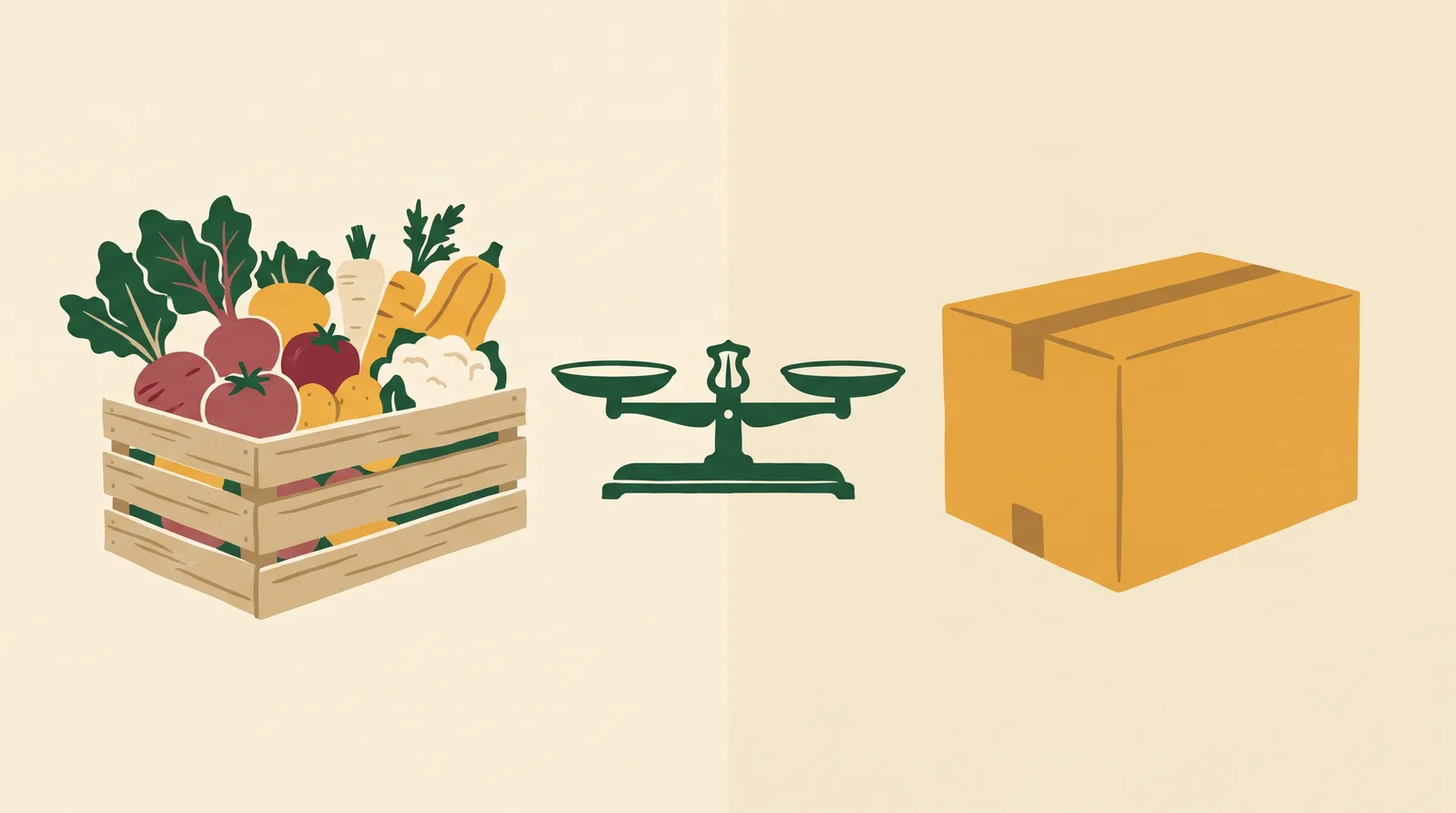
A farmers market is a shared space where many farmers sell direct, and you buy item by item on the market day. A CSA is a subscription to one farm's harvest — you pay before the season and collect a weekly box. Same "direct from the farm" spirit, completely different commitment.
That difference cascades into everything else. At a market you compare vendors, taste before you buy, and walk away with precisely what you wanted — but only on the day the market runs, usually once or twice a week. With a CSA you give up that week-to-week choice in exchange for a standing supply and a real relationship with the growers, who are sharing their season's bounty (and risk) with you. Neither is "better" — they suit different cooks. If you're still fuzzy on the CSA model, our what is a CSA guide covers the basics, and is a CSA worth it walks the cost-benefit.
Cost: two different spending models
A CSA is a lump-sum commitment — roughly $25–$45 a week billed up front, about $400–$1,100 for a season (2026 farm price sheets). A farmers market is pay-as-you-go — spend $5 or $50, whenever you go. The CSA can win on per-pound value for organic produce; the market wins on flexibility and zero commitment.
Concretely: Who Cooks For You Farm's 2026 summer shares run $27–$45/week across sizes, and Just Roots offers a 20-week sliding scale from $270 to $950. That's real money committed before you've eaten a thing — worth it only if you use the box. At a market there's no commitment at all, but prices swing by item: in-season conventional produce can undercut the grocery store, while organic frequently carries a premium (a Utah comparison found a market basket ran 17% above grocery for conventional and 27% above for organic, though other regions have found markets cheaper — it genuinely depends on item and area). The honest takeaway: don't choose on price alone, because neither reliably wins. If you have a real share price in hand, our CSA cost calculator compares it against your current produce spend in a few seconds.
Choice and convenience: the real trade
This is where they truly diverge. The market gives you total choice but only on its schedule; the CSA gives you a standing supply but the farm decides what's in it. If having no say over your produce sounds freeing, lean CSA. If it sounds frustrating, lean market.
CSA research is blunt about the friction: a meaningful share of members report getting too much produce (about 24% in studies), frustration with the lack of choice (roughly 11–14%), and inconvenient fixed pickup times (around 23%). And tellingly, letting members customize the box did not reliably fix retention in one California study — so "I'll just swap what I don't want" isn't the clean escape hatch it seems. A farmers market sidesteps all of this: you only buy what you'll use, the day you'll use it. The cost is that the market runs once or twice a week and you have to show up.
Freshness and supporting local: basically a tie
Both crush the grocery store on freshness and both keep your money in the local farm economy. Produce from either has typically traveled a short distance and been picked at peak ripeness, versus the roughly 1,500 miles conventional supermarket produce travels. On these two dimensions, CSA and market are close to even.
A CSA box is often harvested within a day of your pickup; market produce within a day or two of the market — both far fresher than supermarket produce picked under-ripe for long transit. Buying from either also sends nearly the whole dollar to the grower instead of the roughly 15.8% of the conventional grocery food dollar that reaches the farm. (The often-cited "$62 of every $100 stays local at a market" figure is real but methodology-dependent — treat it as directional, not gospel.) Bottom line: if freshness and supporting local are your goals, either choice delivers — so decide on choice, commitment, and convenience instead.
Side-by-side
| CSA | Farmers market | |
|---|---|---|
| How you pay | Lump sum, up front | Pay-as-you-go, per visit |
| You choose the items? | No — you get the harvest | Yes — every item |
| Variety in one stop | One farm's produce | Many farms + meat, eggs, bread, crafts |
| Commitment | A full season | None |
| Schedule | Fixed weekly pickup | Market day (1–2×/week) |
| Freshness | Excellent | Excellent |
| Supports local farms | Strongly | Strongly |
| Best for | Constant cooks who like surprise | Shoppers who want choice + flexibility |
So which should you choose?
Choose a farmers market if you want to pick every item, value flexibility, and like the weekly outing. Choose a CSA if you cook most nights, enjoy seasonal surprise, and want to commit to one farm. Do both if you want a reliable produce base plus the freedom to fill in — a CSA share for staples, the market for fruit, eggs, meat, and whatever inspires you that week.
The lowest-risk move is to start at a market — there's no commitment, and a few visits will tell you fast whether you love cooking from fresh local produce. If you find yourself there every week buying the same vegetables, a CSA share will likely save you steps (and maybe money). Ready to look? Find a farmers market by state or browse CSAs near you. And if you're also weighing an online produce box, see CSA vs. grocery delivery.
Frequently asked questions
What's the main difference between a CSA and a farmers market?
Choice and commitment. A farmers market lets you walk up and buy exactly what you want, from many farms, on the market day — no commitment. A CSA is a season-long share of one farm's harvest: you pay up front and get whatever that farm grows each week, in a box you don't hand-pick. The market is pay-as-you-go and you choose; the CSA is paid-in-advance and the farm chooses.
Is a CSA cheaper than a farmers market?
Not in a simple way. A CSA can deliver good value per pound of organic produce because you're buying in bulk direct from one farm, but you commit a few hundred dollars up front and only save if you use everything. A farmers market has no commitment, but prices vary by item — in-season conventional produce can beat the grocery store while organic often carries a premium. Neither is reliably 'cheaper'; they're different spending models.
Which is fresher, a CSA or a farmers market?
Both are excellent and far fresher than a grocery store, because produce is harvested close to when you get it instead of traveling roughly 1,500 miles through a distribution chain. A CSA box is often picked within a day of your pickup; market produce is typically harvested within a day or two of the market. The freshness difference between the two is small — the big jump is over the supermarket.
Can you use SNAP/EBT at both?
Often, yes. Many farmers markets accept SNAP/EBT (frequently via a token system at the info booth) and a growing number run matching programs that stretch those dollars. A growing number of CSAs also accept SNAP/EBT or offer sliding-scale and cost-offset pricing. Availability is local — check the specific market or farm.
Can you do both?
Absolutely, and many people do. A common pattern is a CSA share for your staple weekly vegetables plus the farmers market for the things the box doesn't cover — fruit, meat, eggs, bread, or simply ingredients for a specific recipe. The CSA anchors your cooking; the market fills the gaps and stays fun.
CSA guides: What is a CSA? · What's in a CSA box · Is a CSA worth it? · CSA cost calculator · Find a CSA near you
Buying direct: honest comparisons: Farmers market vs grocery store · U-pick vs farm stand vs market · CSA vs grocery delivery
Sources
- Just Roots Farm — 2026 Summer CSA (current share prices + values)
- Who Cooks For You Farm — CSA Plans & Pricing (2026 tiers)
- USU Extension — Farmers Market vs Grocery Store price comparison
- Galt et al. — CSA member retention & the customization paradox (eScholarship)
- CEFS — Research-based support for local food systems (freshness, food miles)
- USDA AMS — Community Supported Agriculture directory
- USDA AMS — National Farmers Market Directory
CSA prices come from farms' published 2026 sheets and vary widely; the price-comparison percentages come from regional studies (Utah, ~2016–2017) and are labeled by region and year — markets are not uniformly cheaper or pricier than the grocery store. Food-mile and local-multiplier figures are widely-cited but methodology-dependent and are presented as directional. A note from the Editor: this guide is checked against its primary sources and updated as newer data becomes available.