Farmers Market vs Grocery Store: What the Price Data Actually Says
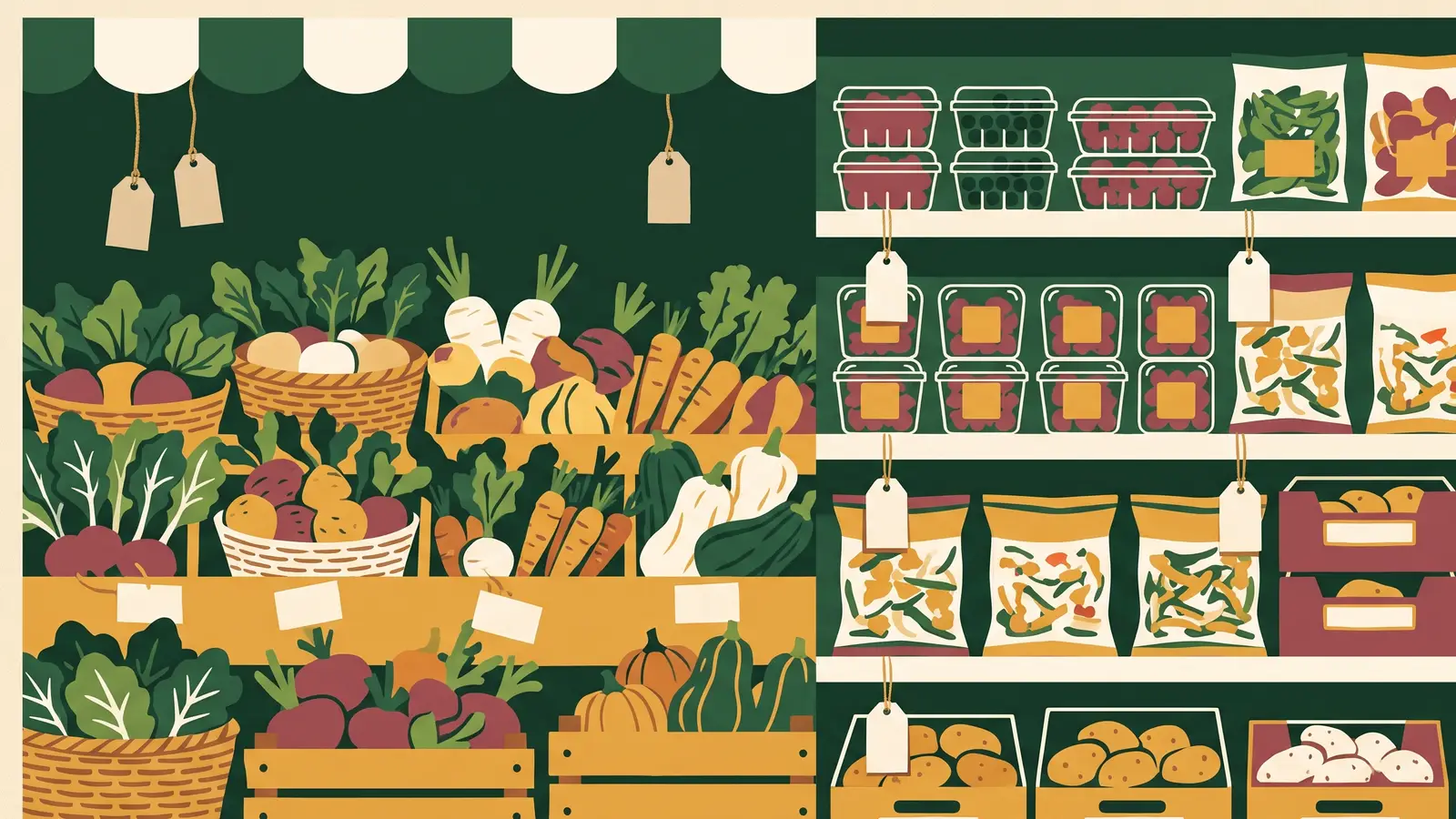
So, are farmers markets cheaper than grocery stores?
The honest answer is that it depends on the item. The most-cited controlled comparison — 11 California farmers markets measured against 7 nearby supermarkets — found that conventional fresh produce cost about $3.68 more per week for a family of three at the market, while organic produce cost $16.34 less per week than the same organic items at the supermarket.
That one study captures the whole picture: averages hide a split between categories. Shoppers who price conventional bananas or bagged carrots tend to conclude that markets are expensive. Shoppers who buy organic greens, heirloom tomatoes, or eggs reach the opposite conclusion. Both are right about their own basket. The 2026 ASAP price brief found the same pattern: of nine seasonal vegetables compared, six were roughly even with retail, carrots and potatoes ran about $1 a pound more at the market, and pasture-raised eggs were cheaper. The market doesn't beat the store on everything — it beats it on the items stores mark up the most.
Where the farmers market actually wins on price
Markets tend to be cheaper on certified-organic produce, pasture-raised eggs, and whatever is in peak season that week. These happen to be the items supermarkets mark up the most, because the store is paying for certification, refrigerated shipping, and shelf life that a farmer selling directly to you skips entirely.
USDA's Price Spreads data explains the reason. For most foods, the farmer takes home only a fraction of the retail price; the rest covers processing, packaging, transportation, and the store's own margin. A vendor handing you eggs across a folding table has removed almost all of those middle steps. So when you buy the things where those post-farm costs pile up — organic certification, delicate greens, fresh eggs — buying direct strips out the part of the price that isn't the food itself. When you buy shelf-stable staples that a supermarket moves by the truckload, the store's scale wins instead.
Where the grocery store wins
Supermarkets are cheaper and more convenient for pantry staples, out-of-season produce, and anything on a fixed weekly list. They also win on selection, predictable hours, and one-stop shopping — you can't pick up detergent, flour, and frozen fish at most markets.
A clear-eyed county study published in 2018 is worth taking seriously. It found that the local market had a smaller selection, shorter hours, higher prices on several items, and even sold some foods of questionable nutritional value alongside the produce. Markets aren't automatically a health-food paradise or a bargain bin. For a household buying rice, canned goods, and a single tomato in February, the grocery store is both cheaper and easier — and pretending otherwise is a quick way to send someone home disappointed after one overpriced trip.
The advantage that has nothing to do with price: freshness
Market produce is usually picked within a day or two of sale and skips the multi-day warehouse-and-truck journey that supermarket produce travels. It arrives riper, tastes more like it should, and often lasts noticeably longer in your refrigerator — which can quietly offset a higher price by reducing waste.
This is the part regular shoppers talk about and spreadsheets miss. A head of lettuce that lasts ten days instead of four changes the real cost per meal, even if it rang up higher at the register. You're also buying varieties chosen for flavor rather than durability in shipping — which is why a tomato bought at the market in August and one from the supermarket shelf barely taste like the same thing.
Do farmers-market shoppers actually eat better?
The connection is real, though it isn't proof of cause and effect. In a study of 400 low-income women in North Carolina, 42.1% of the farmers-market shoppers ate five or more servings of fruits and vegetables a day, compared with 24.0% of those who didn't shop at markets — roughly a 1.5 times higher rate.
A separate analysis found that areas with more farmers markets had slightly lower rates of diabetes — about 0.78% lower for every 1,000 residents living near a market. These are associations, not proof: people who are already inclined to eat well may also be the ones who seek out markets. But the pattern holds across studies, and the explanation is straightforward — it's simply easier to eat more vegetables when you're surrounded by fresh ones you're excited to cook.
A quick word on the "food miles" idea
Buying local does less for the climate than the marketing suggests. Research puts transportation at only about 4% of the total greenhouse-gas footprint of food. What you eat — particularly how much red meat and dairy — matters far more than how far it traveled.
This isn't a reason to skip the market; it's a reason to shop there for the benefits that actually hold up. Freshness, flavor, variety, supporting local farms, and knowing who grew your food are all genuine. Shrinking your carbon footprint through food miles mostly isn't — and overstating it just hands a skeptic an easy rebuttal. It's better to be accurate about where the real value sits.
Side-by-side: who wins at what
| Category | Usually cheaper / better |
|---|---|
| Organic produce | Farmers market |
| Pasture-raised eggs | Farmers market |
| Peak-season fruit & veg | Farmers market |
| Freshness & shelf life | Farmers market |
| Conventional produce (average) | Grocery store |
| Pantry staples & canned goods | Grocery store |
| Out-of-season produce | Grocery store |
| Selection & hours | Grocery store |
| Produce with SNAP + Double Up match | Farmers market |
SNAP, EBT, and Double Up: how shoppers on a budget come out ahead
This is where the price question tips clearly in the market's favor. Many markets accept SNAP/EBT, and a growing number run Double Up Food Bucks, which matches SNAP dollars spent on produce up to a daily limit (commonly $20 to $50). With a match, you're buying fruits and vegetables at roughly half price — almost always less than the same produce at a supermarket.
It matters more in 2026 than it used to. The federal nutrition-education funding that once promoted shopping at markets was eliminated as of October 1, 2025, so the programs that remain — SNAP acceptance and Double Up at the market level — are carrying more of the load of getting fresh food to families on a tight budget. If you're on SNAP, finding a participating market is one of the highest-value moves available to you. Our guide to farmers markets that accept SNAP/EBT can help you find one nearby.
How to actually save money at a farmers market
You can shop a market on a budget — it just isn't automatic. Buy what's in peak season, compare egg and organic prices against your store, shop near closing time for markdowns, bring cash, and use SNAP plus Double Up wherever it's offered.
A few more habits that regular shoppers rely on: build your meals around what's abundant and cheap that week instead of arriving with a fixed list; talk to the vendors, who will often discount the last few flats rather than haul them home; buy "seconds" — the slightly blemished produce — for sauces and freezing; and skip the prepared-food and specialty stalls if saving money is the goal, since that's where markets get expensive. Treat the market as the place to win on produce and eggs, and the grocery store as the place to win on everything else.
The verdict
It doesn't have to be either-or, and price isn't really the point. The households that eat best tend to use both — the farmers market for organic produce, eggs, and in-season specialties (especially with a SNAP match) and the grocery store for staples, out-of-season items, and convenience. Markets aren't always the cheaper option, but they're often the better-food option, and that's the reason worth showing up for.
If you wrote markets off after one pricey visit, it's worth a second try with a produce-and-eggs plan during peak season — and tasting the difference for yourself, which is honestly the most convincing argument there is. That's the whole idea behind this site: not to talk anyone into anything, just to make the better options easier to find. Ready to look? Browse markets that accept SNAP/EBT, or find a farmers market by state.
Frequently asked questions
Are farmers markets cheaper than grocery stores?
It depends on what you're buying. In a controlled California study, conventional produce ran about $3.68 a week more for a family of three at farmers markets, while organic produce cost $16.34 a week less than organic at the supermarket. Pasture-raised eggs and peak-season items also tend to be cheaper at the market; staples like carrots and potatoes are usually cheaper at the store.
Is farmers market produce actually fresher than grocery store produce?
Usually, yes. Market produce is typically harvested within a day or two and skips the multi-day distribution chain that supermarket produce travels through, so it arrives riper and tends to last longer at home. The trade-off is selection and predictability — you buy what's in season that week, not a fixed year-round assortment.
Do farmers markets accept SNAP/EBT?
Many do, and a growing number run Double Up Food Bucks, which matches SNAP dollars spent on produce up to a daily limit (commonly $20 to $50). With a match, SNAP shoppers buy fruits and vegetables at roughly half price, which often makes the market the most affordable place to buy produce.
Is it worth shopping at a farmers market if money is tight?
Often, if you shop with a plan: buy what's in peak season, compare egg and organic prices against your store, go near closing time for markdowns, and use SNAP plus Double Up where it's available. For out-of-season items and pantry staples, the grocery store still usually comes out ahead.
Does buying local at a farmers market reduce your carbon footprint much?
Less than most people assume. Research finds that transportation — the 'food miles' — accounts for only about 4% of the greenhouse-gas footprint of food; what you eat matters far more than how far it traveled. Local buying has real benefits for freshness and the local economy, but it's a small lever on emissions.
Buying direct: honest comparisons: CSA vs farmers market · U-pick vs farm stand vs market · CSA vs grocery delivery
Market basics & programs: First-timer's guide · Double Up Food Bucks · WIC at the market · Find markets near you
Sources
- Cost of fresh produce at farmers markets vs supermarkets (Nutrients, 2022)
- Farmers markets, diabetes prevalence & food miles (J. Nutrition, 2015)
- Farmers market shopping & fruit/vegetable intake in low-income women (Ecol. Food Nutr., 2013)
- A county farmers market evaluation — limitations (Prev. Chronic Dis., 2018)
- ASAP 2026 farmers market vs retail price brief
- USDA ERS Price Spreads from Farm to Consumer
Figures are drawn from the peer-reviewed studies and public datasets linked above. Prices vary by region, season, and year, so treat the category patterns — not the exact dollar figures — as the durable takeaway. A note from the Editor: this guide is checked against its primary sources and updated as newer data becomes available.