CSA vs. Grocery Delivery & Meal Kits: Which Is Worth It?
What each one actually is
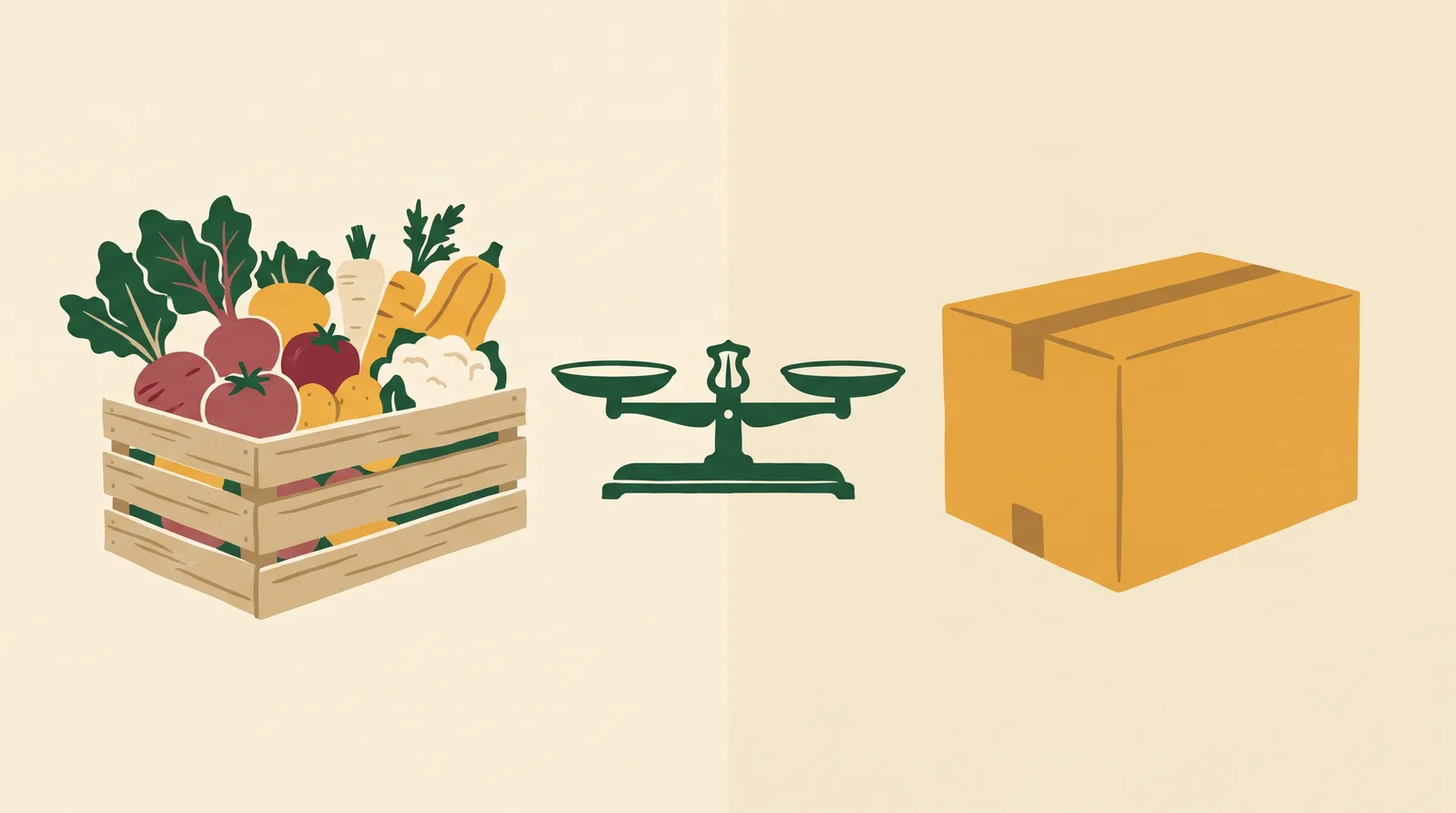
A CSA is a membership in one local farm's harvest. Online grocery-delivery and meal-kit services are national retailers that ship produce and groceries from distribution centers. One is a farm relationship; the other is a store that comes to your door.
With community-supported agriculture (CSA), you buy a "share" of a local farm's season before it starts, becoming a member in a direct partnership with the grower (NC State Extension; University of Kentucky Center for Crop Diversification). Most are farmer-run. The harvest season typically runs 18–26 weeks, and a weekly box holds roughly 10 pounds of 5–12 kinds of produce — smaller early and late, up to about 20 pounds at summer's peak. The food comes straight from that farm, usually harvested a day or two before you pick it up.
The delivery services are a different animal entirely:
- Misfits Market (which acquired Imperfect Foods in 2022) sells cosmetically "imperfect" produce, overstock, and short-coded goods at a discount to retail, shipped from regional warehouses to the lower 48 states. You choose your items, there's no membership required, and you can cancel anytime.
- Hungryroot is a hybrid meal-kit and grocery service: a quiz drives an algorithm that auto-fills a cart of groceries plus simple recipes. It's the priciest of the group and is really a meal-solution service, not a cheap-produce play.
- Thrive Market is a membership pantry store for non-GMO and specialty shelf-stable foods — not a fresh-produce box at all, but a common complement to one.
- Instacart isn't a store; it's a delivery layer over local retailers. Maximum choice and convenience, but you pay retail prices plus fees, and none of it is especially local.
Cost, honestly
Neither is a clear budget winner. A CSA share works out to roughly $2.00–$2.50 per pound of local produce, competitive with a delivery box once its fees are added in — but you commit a few hundred dollars up front, and it isn't refundable. Delivery is pay-as-you-go, with fees and minimums layered on top.
A CSA full share commonly runs $15–$35 a week, about $400–$700 for the season (premium and diversified shares climb toward $1,000). That money funds the farmer's seeds and early labor before a single tomato ripens — which is exactly why it isn't refundable if the weather turns. A Misfits Market produce box, by comparison, runs about $22 for the smaller box up to ~$35 for the large one, plus roughly $10–$12 in shipping and handling, with a $59 cart minimum (2025 pricing). It's marketed at roughly 20–40% under grocery-store produce prices, and there's no season-long commitment. Hungryroot sits well above both, with order minimums around $65 a week.
The honest read: on a per-pound basis a CSA is often the better deal for local produce, but the numbers matter less than the cash-flow and risk difference. A CSA asks you to pay for the whole season in advance and share the farm's crop risk; a delivery box lets you spend week to week and walk away whenever. For most households that difference decides it, not the math — though if you want the math anyway, the CSA cost calculator does it with your own numbers.
| CSA full share | Online produce box (e.g. Misfits) | |
|---|---|---|
| Headline price | ~$15–$35/wk; ~$400–$700/season | ~$22–$35/box + ~$10–$12 fees |
| How you pay | Lump sum, up front | Pay-as-you-go |
| Refundable? | No — you share crop risk | Cancel/skip anytime |
| You choose items? | No — you get the harvest | Yes — customize the box |
| Minimums / add-ons | None per box | $59 cart minimum + shipping |
Freshness & food-miles: the CSA's real edge
This is where a CSA genuinely pulls ahead. Its produce is typically harvested about a day before you get it, from a local farm. Every delivery service — however well-run — ships from regional distribution centers, so the food inherently travels farther and takes longer to reach you.
Freshness isn't just a taste preference; it's measurable. Produce loses nutrients steadily after harvest, so food eaten within a day or two of picking retains more than produce that spent days in transit and storage. A CSA's short farm-to-kitchen path also has a real environmental payoff: a 2022 Iowa State University life-cycle assessment found that local small- and medium-scale vegetable production generated less than half the greenhouse-gas emissions and used roughly a tenth of the water of large-scale conventional production. National delivery logistics, no matter how optimized or carbon-offset the marketing, can't match a same-week local harvest on food-miles. Frame this as locality, not "delivery is bad" — but if freshness and footprint are your priorities, the CSA wins cleanly.
Flexibility & commitment: delivery's real edge
Here the trade flips. Delivery services let you skip, pause, cancel, or customize anytime, and you're buying finished inventory — no risk to you if a crop fails. A CSA is a season-long commitment to whatever is ripe, on a fixed schedule.
The friction that makes people quit a CSA is well-documented: the single most common reason members don't renew is being overwhelmed by the volume — 10 pounds a week (up to 20 at peak) demands real cooking, freezing, or preserving, or it becomes waste. Add a rigid pickup time and location, and unfamiliar vegetables you didn't choose, and a CSA can feel like a chore for the wrong household. Delivery sidesteps all of it: you pick your items, order when it suits you, and skip the weeks you're traveling. For picky eaters, small households, and unpredictable schedules, that flexibility is worth more than locality — and that's a perfectly reasonable call.
Supporting local vs. rescuing food
A CSA keeps your money with a nearby farm; the imperfect-produce services keep food out of the landfill. Both are legitimate values — they're just different ones.
Direct-to-consumer farm sales reached about $3.3 billion in the 2022 Census of Agriculture, up roughly 25% since 2017 — a CSA sends nearly your whole dollar to the grower rather than a distribution chain, and studies suggest local-food spending recirculates more within a community (the exact multipliers come from advocacy sources, so treat them as directional). The delivery services counter with a real food-waste story: roughly 40% of U.S. food goes uneaten, much of it for cosmetic reasons, and Misfits and Imperfect built their model on intercepting that produce. If you want your grocery spending to fight food waste more than it supports a specific local farm, that's a genuine point in delivery's favor.
One note on the 2024–2026 market
The delivery category has cooled and consolidated since its pandemic peak. U.S. meal-kit revenue grew only about 2.8% in 2025 (to roughly $9.1 billion) as shoppers drifted back toward cooking from grocery hauls. Misfits Market acquired Imperfect Foods in 2022 and then cut its workforce and closed fulfillment centers across 2022–2023; Blue Apron was taken private by Wonder Group in 2023. None of this makes the services a bad choice — they're stable and widely used — but it's worth knowing the category is a maturing business, not a rocket ship, when you're weighing a subscription.
So which should you choose?
Choose a CSA if you cook most nights, want the freshest local food, and want to back a nearby farm. Choose grocery delivery if you want to pick your own items, need cancel-anytime flexibility, or travel often. Do both if you want local summer produce plus year-round pantry and convenience.
The lowest-risk way to find out whether local produce fits your kitchen is to start without a commitment: a delivery box or a few farmers-market visits will tell you fast whether you enjoy cooking from fresh, seasonal ingredients. If you find yourself craving that every week — and you're up for the volume — a CSA share turns it into a season-long habit and sends the most money to the farm. Ready to look? Browse CSA farm shares near you, or find a farmers market by state to try the pay-as-you-go version first. Still deciding between the two local options? See CSA vs. farmers market and is a CSA worth it?.
Frequently asked questions
What's the difference between a CSA and a service like Misfits Market?
A CSA is a season-long share of one local farm's harvest — you pay up front, get a box of whatever that farm grows each week, and the food is usually picked within a day of pickup. Misfits Market and similar services are national online stores that ship rescued or overstock produce from regional warehouses; you choose your items, pay per order, and can cancel anytime. The CSA is local and committed; the delivery box is national and flexible.
Which is cheaper, a CSA or an online produce box?
It depends on how you shop. A CSA full share works out to roughly $2.00–$2.50 per pound of local produce, which is competitive once you add a delivery box's shipping and service fees — but the CSA is paid in full up front and is non-refundable. A service like Misfits Market runs about $22–$35 per box plus roughly $12 in fees with a cart minimum, but it's pay-as-you-go and cancelable. Neither is reliably cheaper; the real difference is committing cash up front versus paying as you go.
Is a CSA fresher than grocery delivery?
Generally, yes. CSA produce is typically harvested about a day before you get it, straight from a local farm. Even the most optimized delivery service ships from a handful of regional distribution centers, so it inherently travels farther and takes longer. Freshness and food-miles are a CSA's clearest, most defensible advantage.
Which is more flexible?
Grocery delivery, clearly. Services like Misfits Market let you skip, pause, cancel, or customize your box anytime, and you're buying finished inventory so there's no risk to you if a crop fails. A CSA is the opposite: you commit for the season, share the farmer's weather risk (usually with no refund on crop loss), and receive whatever is ripe on a fixed pickup schedule. If your schedule is unpredictable, delivery wins.
Should I do a CSA or a delivery box?
Pick by what you value. Choose a CSA if you cook most nights, want the freshest local food, and want your money to support a nearby farm. Choose grocery delivery if you want to choose your own items, need cancel-anytime flexibility, or travel often. Many households do both — a CSA for summer produce and a delivery service for year-round pantry and convenience.
CSA guides: What is a CSA? · What's in a CSA box · Is a CSA worth it? · CSA cost calculator · Find a CSA near you
Buying direct: honest comparisons: Farmers market vs grocery store · CSA vs farmers market · U-pick vs farm stand vs market
Sources
- NC State Extension — Growing Small Farms CSA guide (2026)
- University of Kentucky — Center for Crop Diversification: CSA overview
- Iowa State University CALS — local vs. large-scale produce life-cycle assessment (2022)
- USDA 2022 Census of Agriculture — direct-to-consumer farm sales
- USDA AMS — Community Supported Agriculture directory
- USDA AMS — National Farmers Market Directory
- The Kitchn — Misfits Market review & 2025 pricing
- Grocery Dive — Misfits Market acquires Imperfect Foods (2022)
CSA prices come from farms' published 2026 share sheets and vary widely by region and farm. Delivery prices reflect 2025 published rates (Misfits Market) and change frequently — check the service's live pricing before subscribing. Food-mile and local-economy figures are widely cited but methodology-dependent and are presented as directional. A note from the Editor: this guide is checked against its primary sources and updated as newer data becomes available.