What Is Purslane?
What it is
Purslane · Portulaca oleracea
Purslane (Portulaca oleracea) is an annual succulent in the Portulacaceae family (USDA PLANTS). Both stems and leaves are edible. Long a staple in Mediterranean and Mexican cooking (verdolagas), it's been classified as a nuisance weed in North America — Mississippi State Extension files it under 'forgotten foods' — which is why you'll find it at farmers markets and almost nowhere else.
Why you won't find it in grocery stores
It's managed as a persistent weed rather than farmed as a crop, and at roughly 94% water it wilts and ships terribly. A crop nobody plants and nobody can truck is a crop only a local market table can sell.
What it tastes like
Mild, tangy-sour, with a fleshy, crunchy bite — raw it's a crisp, lemony salad green; cooked it lands somewhere between okra and spinach.
When it's in season
A summer annual that runs on water-efficient C4 photosynthesis — it thrives in heat and drought and is most abundant at the peak of summer, exactly when tender lettuces give up.
How to spot it at a farmers market
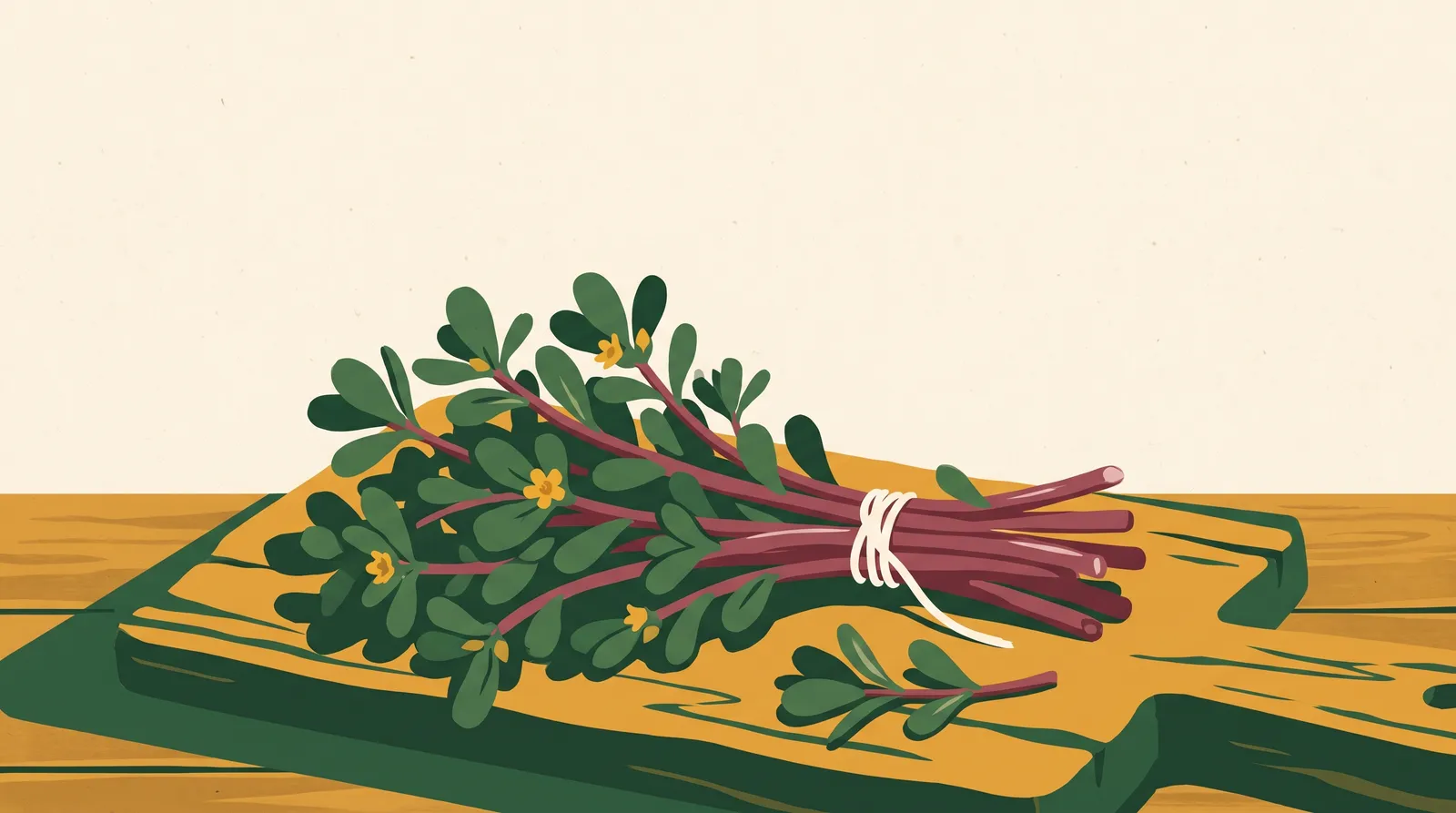
Fresh leafy bunches of thick, smooth, succulent stems with a reddish-pink hue and bright-green, teardrop-shaped fleshy leaves — plumper than any salad green — with tiny yellow 5-petal flowers at the stem joints.
How to use it
We link to trusted preparation guides rather than writing recipes — these are the ones we'd hand a friend (all checked and working as of our last update):
Frequently asked questions
What is purslane good for?
It's one of the most nutrient-dense greens sold anywhere — unusually high in plant omega-3s, plus vitamins A, C, and E, calcium, magnesium, and iron. Use it raw in salads (crunchy, lemony) or cooked like spinach.
How do I tell purslane from spurge?
Snap a stem. Toxic spotted spurge bleeds milky white sap; edible purslane runs clear. Spurge stems are also thin and hairy where purslane's are thick, smooth, and succulent — and spurge flowers whitish-pink where purslane's are yellow.
When is purslane in season?
Peak summer. It's a heat-and-drought-loving C4 annual, most abundant in July and August — the very weeks delicate greens disappear from market tables.
Can my dog eat purslane?
No — purslane's dense calcium-oxalate content is toxic to dogs, cats, and horses, and oxalate poisoning is documented in sheep and goats. It's a people-food only.
Where to find it
Small growers are the whole supply chain for produce like this. Ask at your local farmers market, check farm stands near you, or search by ZIP with the market finder — and if a vendor doesn't have it, ask who might; growers know each other.
Meet the market's stranger produce
A short seasonal email: what's peaking at farmers markets this month — including the unusual stuff worth asking for. No spam, unsubscribe anytime.
→ What's in season right now · Month-by-month calendar
More unusual finds: Pawpaw · Ground Cherry — or the everyday crops: Tomatoes · Sweet Corn · Watermelon · Peaches
Sources
- USDA PLANTS — Portulaca oleracea (common purslane)
- Mississippi State Extension — Forgotten Foods: Common Purslane
- Cornell CALS — Common Purslane (weed profile)
- University of Wisconsin Horticulture — Spotted Spurge (Euphorbia maculata)
- Cosmetic Ingredient Review — Safety Assessment of Portulaca oleracea
Identification and safety guidance above comes from university extension and peer-reviewed sources. When foraging or trying unfamiliar produce, buy from a knowledgeable grower rather than self-identifying in the field — look-alikes are real, and your market vendor handles them every week.